
A few years after high school graduation in 2006, Brittany Reynolds enrolled at the community college with dreams of becoming a nurse.
When denied financial aid, she had to drop out — but that disappointment became the ticket to a career in water treatment. And she couldn’t be happier.
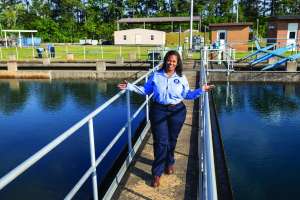
Reynolds works for Birmingham (Alabama) Water Works as the lead operator at the Western Filter Plant. She has a Grade IV Water Operator certification (the state’s highest) and is pursuing a master’s degree in business administration.
She loves every aspect of the job but has a special passion for training new team members, especially those from under-resourced communities like the one she grew up in, where access to education, health care and career opportunities was limited. “I am a first-generation college graduate,” she says. “My mother was a teen mom and worked two jobs to provide for my sisters and me.”
In 2024 Reynolds was named Operator of the Year by the AWWA Alabama-Mississippi Section. “My superintendent Lorenzo Clay nominated me,” she says. “I was not expecting it because talented operators at Birmingham Water Works surround me. I’m going to keep striving to win it again.”
Reynolds was born in Birmingham and has always lived there. When she had to leave school, she also quit her waitressing job and in 2010 took a job at the Bessemer Water Treatment Plant as a maintenance worker, with no experience.
During her daily tasks of maintaining equipment, cutting weeds and cleaning basins, she saw something that completely changed her career goals: “I fell in love with water treatment and lost my desire to be a nurse. I never thought that would happen, but once I saw the process and how things worked and what we were doing for the community, I knew I wanted to be an operator.”
Within six months, she started working on her Grade IV certification. “It was stressful,” she says. “Here and there I would attend a class, but mostly I studied on my own. And if I didn’t pass the test within a certain amount of time, my boss said he would have to let me go.”
But in reality, he was on her side and had a plan for her all along. “Sometimes we don’t even know we’re being hired for a purpose,” Reynolds says. “When he hired me, I thought it was just for maintenance, but later he told me he hired me to become an operator. He had over 20 years in water treatment and had never hired a woman before. I said, ‘I promise I won’t disappoint you.’”
Reynolds kept her promise. She got her certification and became an intern-operator in 2011. At first her male colleagues were a little uneasy having a woman on staff, but they grew to respect her and, she recalls, gave her lots of encouragement.
By 2012 she was a full-time night-shift operator. Along the way bought her first home, got married and gave birth to a son. “Life was just happening before my eyes,” she says.
Reynolds stayed at the plant for seven more years and in 2019 made a change. With encouragement from family and friends, and the promise of tuition reimbursement, she went to work for Birmingham Water. She started as a night-shift helper, a demotion, but she knew that opportunities awaited and that she would be able to finish school.
She re-enrolled at Lawson State Community College and earned an associate degree in business administration in August 2022. In 2024 she earned a bachelor’s degree in business administration with an emphasis on management from the University of West Alabama. Now she is working on her MBA, which she expects to complete in December 2025.
Meanwhile, Reynolds moved up to night-shift operator, and in November 2021 she became lead operator on the day shift. “It was a pay cut,” she says, “But I didn’t care because I wanted to learn the day shift. On the night shift, everything is closed and quiet. I wanted to know all the parts and pieces that make this clock tick.”
The Western Filter Plant (60 mgd capacity, 40 mgd average) was built in 1964 and upgraded in 1972, 1980 and 2012. Its 21-member staff is led by Lorenzo Clay, superintendent; Bruce Johnson, maintenance supervisor; and Jeremy Hawkins, senior operator.
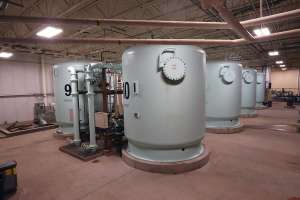
Source water is supplied from the Sipsey Fork and the Mulberry Fork of the Black Warrior River. The utility has 20 million gallons of storage capacity. The plant’s conventional treatment process includes five settling basins (Ovivo). Chlorine gas disinfectant is added ahead of 6 dual media filters with stainless steel underdrains (AWI Phoenix Lateral Underdrains [AWI-US]) and a rating of 4 gpm per square foot.
Turbidity meters (SWAN Analytical USA) are used throughout the process, including on each filter’s effluent. The plant’s three clearwells hold a total of 9 million gallons. The plant team manages chlorine byproducts by lowering coagulation pH, lowering filter chlorine and maximizing turnover in the clearwells and tanks. The utility will soon replace chlorine disinfection with sodium hypochlorite.
Reynolds says the plant produces some of the best water in the country and has won the Excellence in Water Treatment award from the Partnership for Safe Drinking Water for 11 consecutive years.
“We go above and beyond in terms of testing,” she says. The Alabama Department of Environmental Management limits filter effluent turbidity to no more than above 0.30 NTU. “But with the partnership, it’s a goal of less than 0.10 NTU on 95% of all filter effluent samples,” Reynolds observes. “The process is challenging, but we are here for it.”
Reynolds has a seven days on, seven days off schedule at the plant. She arrives by 7 a.m. and usually starts by backwashing the filters, along with a helper who begins the morning tests. “We closely monitor iron, manganese and bromine because at times they increase, and that can affect the water if not treated correctly,” Reynolds says. Their filters are backwashed on a 48-hour rotation, ensuring that at least two are cleaned every eight hours.
Reynolds also handles receipt of chemicals, does inline instrument calibrations and works with other departments, including accounting, electrical, maintenance and engineering. “And day shift is where we get things fixed and do preventive maintenance,” she says.
She is also the go-to person for training: “I take pride in teaching people the process of treating water and the importance of it. I have a passion for sharing my knowledge with others. I won’t always be here, and I want to pass on everything I know about the plant.”
She recently began taking part in an outreach program that enables high school students to become Young Water Ambassadors and gives them the chance to explore water treatment as a career. “What I like most about this program is that it shows young people that they can have successful careers without college, which is not for everyone,” Reynolds says. “I wish I had seen the water treatment process when I was in high school.”
For broader community outreach, the utility offers public plant tours and gives back by helping low-income families and the elderly with their water bills, and by providing summer programs for students.
As for home life, Reynolds’ son Michael is now 13 and attends an advanced school. He also plays the trombone, and she loves going to his band recitals. Her advice for balancing work and home: “Pray, meditate, find quiet time.” She admits that isn’t easy; she sometimes feels bad for just sitting down to read a book that isn’t a school text or something about the water industry.
One of her most rewarding tasks is teaching future operators. “I feel like I’m fulfilling my purpose when I am given the opportunity to train and inform,” she says. “If I’m having a bad day, that takes it away, just being able to say, ‘Hey, let me show you how to run this test.’”
Reynolds hopes one day to become a senior operator, then superintendent, manager and finally general manager. “And if I don’t achieve those goals, I’m okay with it, as long as I made an impact, wherever I am. I just hope I’m a blessing to anybody I encounter.”